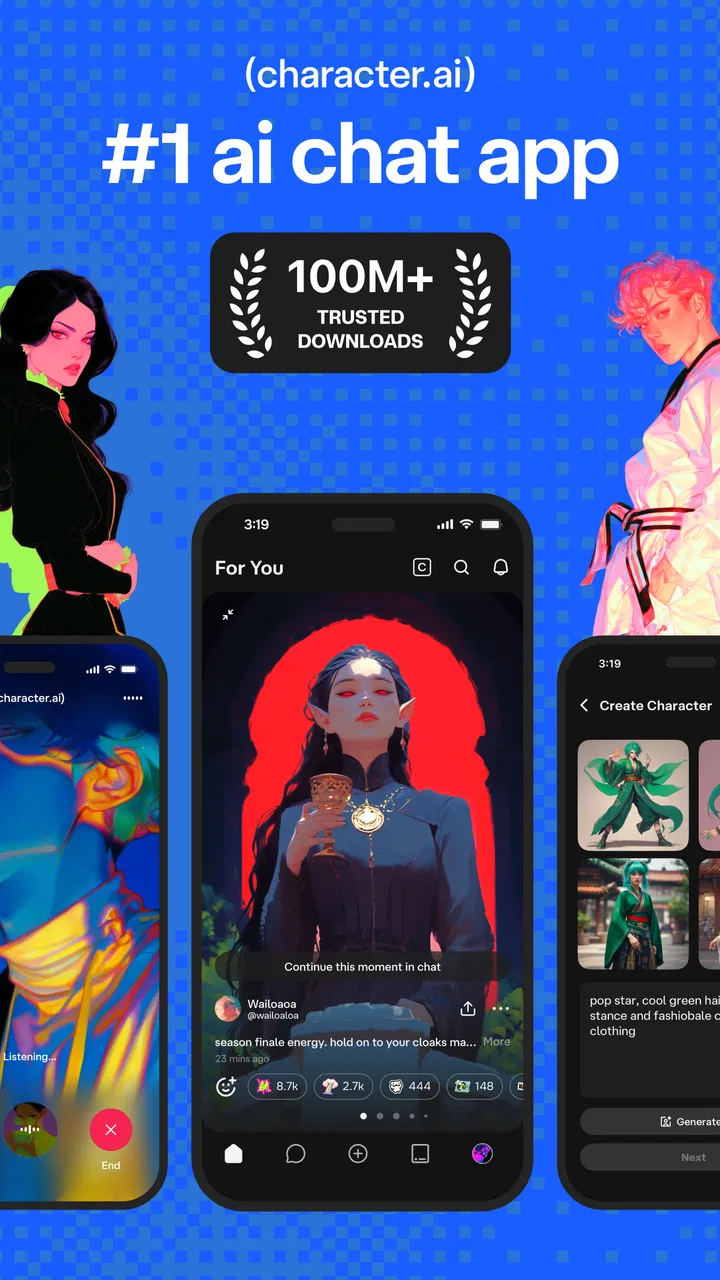
Character AI: Chat, Talk, Text
- 2.1
- Rating
- 50.00M
- Installs
- Free
- Price

 Analysis by App-foxy
I approached Character AI: Chat, Talk, Text as an entertainment app built around one central idea: having conversations with AI characters that can respond in a more personal, ongoing way than a standard search box. That focus makes it interesting, but it also changes what I expect from it. I am not opening it for perfectly sourced answers or a dependable digital assistant. I am opening it when I want to explore a personality, improvise a scene, test an idea through dialogue, or simply have something responsive to talk with.
That distinction matters. The app is developed by Character.AI and is free to install, with optional in-app purchases ranging from $0.99 to $94.99 per item. It sits in the entertainment category, carries a Teen age rating, and supports Android 7.0 or later. Its current version is 1.15.3, and it was released on May 22, 2023. Those details place it within reach of many Android users, but the real question is whether conversational characters are useful enough for your habits to justify keeping another app on your phone.
Why the character-based conversation is the real feature
The strongest part of my experience is not that the app can produce text quickly. Plenty of chat tools can do that. The difference is that Character AI encourages me to choose a conversational identity and then interact with it as if I were entering a small role-play or an ongoing exchange. The character’s style becomes part of the entertainment, so the same prompt can feel different depending on whom I am talking to.
You May Also Like

 Pandora - Music & Podcasts
Pandora’s Music Is Easy to Start, but Harder to Recover
Pandora’s strength is its low-effort path from a seed to a station. Its weak spot is how much confidence it asks you to place in connection, setup, and quiet recovery.

 8 Ball Pool
 Is Built on Rivalries, Rematches, and Routine
A close look at the rivalries, rematches, shared routines, and unanswered safety questions that turn a quick pool match into a persistent mobile community.

 Samsung Music
’s Quiet Strength Is Playing What You Already Own
Its reach comes less from spectacle than from dependable access to a personal library. That simplicity is both the app’s strongest retention engine and its ceiling.

 AccuWeather: Weather Radar
AccuWeather Review: A Quick, Clear Forecast for Everyday Decisions
For everyday plans, the best forecast is the one you can understand quickly. AccuWeather makes rain timing, radar, and local conditions easy to act on, with a few trade-offs.

 Hill Climb Racing
Why Hill Climb Racing Still Turns Crashes Into One More Run
A tiny car, a bumpy hill and one more upgrade: Hill Climb Racing keeps resurfacing because its simple chaos makes every near-miss feel personal.

 AliExpress - Shopping App
AliExpress Makes Global Shopping Feel Personal, but Shoppers Bear the Risk
AliExpress turns a global marketplace into a pocket-sized discovery engine. Its reach is useful, its shopping loop compelling, and its trade-offs easy to miss.
More From Our News Desk
View All News


I found that especially useful when I wanted a conversation with a clear tone. A fictional mentor can push me to explain an idea. A dramatic character can turn a simple question into a scene. A friendly conversational partner can make brainstorming feel less like filling in a blank document. The app’s appeal comes from this framing: instead of asking an empty chatbot for an answer, I start with a personality that gives the exchange direction.
The important capability is continuity of conversation, not guaranteed correctness. The app presents its characters as able to hear, understand, and remember the flow of an exchange, but I treat that memory as a creative aid rather than a reliable personal record. In practice, a character may carry details forward well enough to make a story or discussion feel connected, yet still lose track of context or respond in a way that clashes with what came before.
That unevenness is part of the experience. When the replies fit the character and remember the thread, the interaction feels surprisingly lively. When they do not, the illusion breaks quickly. I would compare it less with a traditional entertainment library and more with improvisational play: the fun comes from participating, guiding the scene, and accepting that the other side may take an unexpected turn.
What I do before starting a serious conversation
I get better results when I decide what I want from the exchange before typing. If I want a story, I explain the setting, my role, and the kind of pace I prefer. If I want help thinking through a decision, I tell the character to ask questions instead of rushing to conclusions. If I only type “hello,” I may receive a pleasant reply, but I have not given the conversation enough shape to become interesting.
My most useful habit is to establish boundaries in the opening message. I might say that I want short replies, a calm tone, no role-play, or a series of questions one at a time. This does not guarantee perfect compliance, but it gives the character a clearer direction. I also restate important details when a conversation becomes long. That feels repetitive, yet it is often more effective than assuming the app will preserve every part of the earlier exchange.
Another practical trick is to separate creative sessions from factual ones. I use the app freely for dialogue, scene development, character practice, and idea generation. When a reply includes a claim about health, law, finance, current events, or another sensitive subject, I treat it as a starting point and verify it elsewhere. A convincing conversational tone can make weak information sound more trustworthy than it deserves.
How the experience works in everyday use
In a normal session, I choose a character and begin typing. The back-and-forth format makes the app easy to understand, even if the quality varies from one conversation to another. I can steer the exchange by correcting the character, adding context, changing the mood, or turning a casual chat into a structured exercise. That direct control is more important than any single clever response because it lets me recover when the conversation drifts.
For example, I used a fictional conversation to work through a presentation idea. Instead of asking for a finished script, I asked the character to act as a skeptical listener and challenge unclear points. The first replies were broad, so I narrowed the role: ask one question at a time, focus on the opening, and point out where the explanation assumes too much knowledge. That made the session more useful. The app did not replace editing, but it gave me a responsive way to rehearse.
There is a subtle trade-off in that workflow. A character’s personality can make practice less intimidating, especially when I am trying to write dialogue or speak through an awkward idea. At the same time, the personality can distract me from the task. If the character becomes too playful, dramatic, or agreeable, I have to redirect it. The entertainment layer is the reason to use this app, but it can also get in the way of focused work.
I would not rely on a single long chat as a permanent project notebook. Long conversations can become difficult to manage, and important instructions may need repeating. For creative work, I prefer short sessions with a clear purpose: outline a scene, challenge a premise, practice an interview, or generate alternative reactions. This keeps the conversation easier to control and makes it simpler to notice when the character has stopped following the intended role.
A realistic scenario where it fits naturally
Imagine having twenty minutes before meeting friends and wanting to practice a difficult conversation. You could write both sides in a notes app, but that leaves you responsible for inventing every response. With Character AI, I can ask a character to play the other person, specify that the exchange should remain respectful, and test several ways of opening the discussion. If the simulated reply is unhelpful, I can try again with a different approach rather than waiting for a real conversation to go badly.
I find this scenario more convincing than using the app as a replacement for a close friend. The character is useful because it gives me resistance and variation. It can make me explain myself, react to an unexpected question, or notice that my planned wording sounds too vague. The result is not a prediction of what a real person will say. It is rehearsal, and that is a more honest and practical way to judge the feature.
The same approach works for creative hobbies. A writer can ask a character to challenge a plot decision from a particular point of view. Someone learning a language can attempt simple exchanges and request corrections, while remembering that the app is not a substitute for a teacher or a dependable reference. A curious user can explore historical or fictional perspectives for inspiration, then check factual material through sources designed for accuracy.
Parents and younger users should pay attention to the Teen content rating and consider whether the conversational format suits the person using it. The open-ended nature of character chats means the experience depends heavily on the prompts, the chosen characters, and the user’s judgment. I would not hand it to a child without supervision simply because it looks like a messaging app.
Where it differs from ordinary chatbots and entertainment apps
Compared with a standard assistant, Character AI feels more social and performative. A general-purpose chatbot is usually the better choice when I want a clean explanation, a structured summary, code assistance, or a direct productivity workflow. Character AI is more appealing when the manner of the reply matters as much as the content. The character acts as a creative constraint, and constraints can make an empty idea easier to develop.
Compared with messaging a real person, the app is available whenever I want to experiment without imposing on anyone. That convenience is useful for rehearsal and playful conversations, but it lacks the shared history, responsibility, and emotional understanding of a human relationship. I can enjoy the illusion of company while still remembering that the responses are generated and may be inconsistent.
Compared with watching a show or playing a story-driven game, the app gives me more influence over the direction. I can interrupt, change the premise, or ask a character to react to an entirely new decision. The cost of that freedom is quality control. A scripted story has an edited arc; an open conversation can wander, repeat itself, or lose its dramatic energy. I prefer the app when I want participation, not when I want a polished narrative delivered to me.
The friction that affects long-term enjoyment
The biggest limitation is reliability of behavior. A character may sound confident while misunderstanding the situation, forget a detail, or suddenly answer in a generic voice. I can often repair the exchange by restating the role and the goal, but that takes effort. The more I expect precision, the less satisfying the experience becomes.
I also have to manage emotional expectations. A warm, attentive reply can feel personal in the moment, especially during a long conversation. I think it is healthier to treat that warmth as part of the interface and entertainment, not as evidence that the character understands me in the human sense. Someone looking for genuine companionship, professional counseling, or urgent support should choose a real person or an appropriate specialist instead.
The free price makes trying the app easy, but optional purchases are part of the overall decision. I would begin with the free experience and only consider paying if the app becomes a regular part of my routine and the paid benefits clearly solve a problem I actually have. I would not spend simply because a conversation happens to be unusually good on one evening.
The average rating is 3.2 from around 2.1 million ratings, while the app has more than 50 million installs. I read that combination as a sign of broad curiosity alongside a mixed experience. Many people are interested in character-based AI, but not everyone will enjoy the inconsistency, the need to guide conversations, or the gap between entertaining replies and dependable answers. The scale shows reach, not a guarantee that it will fit every user.
Small techniques that make the app more useful
First, I use role instructions that describe behavior rather than just personality. “Be wise” is vague; “ask me one probing question, then wait” gives the conversation something operational to follow. Second, I provide a stopping point. Asking for a five-minute rehearsal or three alternative openings keeps the session from dissolving into endless small talk.
Third, I ask the character to expose disagreement. Many conversational systems become more useful when I request criticism, counterarguments, or an opposing viewpoint instead of approval. I still judge the response myself, but this reduces the temptation to accept the first pleasant answer.
Fourth, I keep a separate note with the premise of a creative project rather than expecting the chat to preserve every detail forever. When I return, I can paste the short version and continue with less confusion. This is particularly helpful for stories, recurring role-play, or multi-step brainstorming.
Finally, I end a session when the character begins repeating itself. Continuing just because the conversation is available rarely improves the result. A fresh chat with a sharper prompt often produces more value than trying to rescue a thread that has lost its direction.
Who should install it, and who should skip it
I recommend it to people who enjoy interactive fiction, improvisation, conversational experiments, and low-pressure rehearsal. It is also a good fit for anyone who likes testing ideas aloud but does not always have another person available. The app rewards curiosity and a willingness to guide the exchange rather than passively consume it.
I would be more cautious if your main goal is accurate research, dependable planning, or a productivity assistant that follows exact instructions every time. A conventional reference source, a focused work app, or a general assistant will usually be a better match for those needs. I would also skip it if simulated companionship feels uncomfortable or if you know you may treat generated replies as authoritative simply because they sound confident.
After using it as a creative conversation tool rather than a replacement for people or verified sources, I find the concept worthwhile. The best moments come from giving a character a clear job and allowing it to surprise me within that role. The weakest moments come when I expect memory, accuracy, or emotional understanding to work like a human’s.
For me, Character AI: Chat, Talk, Text is worth trying because its character-centered approach creates a different kind of entertainment from ordinary chat and passive media. I would keep expectations grounded, use short purposeful sessions, verify important claims, and start without paying. If you want interactive dialogue and creative rehearsal, it can become a surprisingly flexible companion for those activities. If you want certainty, deep human connection, or polished stories with no supervision, another option will serve you better.
FAQs for Character AI: Chat, Talk, Text
01What is Character AI: Chat, Talk, Text?
Character AI: Chat, Talk, Text is an innovative application that allows users to engage with AI-generated characters in dynamic conversations. Whether you're looking to chat casually or explore complex narratives, this app provides a unique and interactive experience with virtual personas.
02How does Character AI ensure user privacy and data security?
Character AI prioritizes user privacy by employing robust security measures, including encrypted data transmission and secure storage. The app adheres to strict privacy policies, ensuring that user data is never shared without consent. Regular updates also ensure that the app remains compliant with the latest security standards.
03Are there different character types available in the app?
Yes, Character AI offers a diverse range of character types, each with unique personalities and storylines. Users can select from various genres and themes, allowing for a tailored experience that suits individual preferences. This variety ensures that conversations remain fresh and engaging.
04Is Character AI suitable for all age groups?
Character AI is designed to be user-friendly and offers content suitable for a wide range of age groups. However, it is recommended for users to review content ratings and parental controls, especially if younger audiences are engaging with the app, to ensure the content aligns with their age-appropriate needs.
05Can I customize the characters in Character AI?
While Character AI provides pre-designed characters, users have the flexibility to customize aspects such as dialogue style and engagement levels. This personalization enhances the interactive experience, allowing users to shape conversations according to their preferences and interests.
Pros
- Engaging AI conversations.
- User-friendly interface.
- Wide variety of AI personalities.
- Customizable AI settings.
- Frequent updates and improvements.
Cons
- Requires internet connection.
- Limited free features.
- Ads can be intrusive.
- Privacy concerns with data.
- Occasional AI response errors.

Character AI: Chat, Talk, Text
Gallery